Warehouse picking and packing robots, explained
Moving boxes is solved. Picking one soft, shiny, oddly shaped item out of a crowded bin is still hard for a robot. Between those two sit mobile robots, shelf-carrying robots and grid systems, each with its own pick rate and its own payback. We read the research and the numbers.
Robots That Pick, Pack, and Ship
32 minutes. A narrated research briefing from the Pick Pack Bot editors, with every source checked.
Read what the episode covers
Inside the Sensory Chaos of Fulfillment Centers
Walk into a large fulfillment center and your first thought is not "how philosophically interesting." The place is louder than expected, faster than expected, and it smells exactly like a billion cardboard boxes, because that is what it is. Conveyors run in every direction, forklifts announce themselves with urgent beeping, and people in high-visibility vests walk, and walk, and walk some more, pulling items off shelves and dropping them into totes. This is order picking, and it is by a wide margin the most expensive thing that happens inside a warehouse. Labor devoted to picking accounts for up to 55% of total warehouse operating costs — more than storage, more than receiving, more than shipping, more than everything else the facility does combined. When a single task eats more than half the operating budget, it becomes the primary target for every automation vendor, every efficiency consultant, and every executive who has ever looked at a spreadsheet and felt their eye twitch. The global warehouse automation market is now worth tens of billions of dollars and growing fast. Picking is why.
The global e-commerce explosion made this problem considerably larger in a very short time. Nearly 2 million people work in U.S. warehousing alone. The industry is not known for comfortable working conditions. The injury and illness rate for warehouse workers runs more than double the average across all industries — which, to be clear, includes industries where people operate chainsaws and work at significant heights. Annual turnover in warehousing sits at roughly 49%, meaning about half the workforce quits or gets replaced every single year. Each replacement has to be found, hired, and trained before they can be expected to do it all over again. This is not a great system. Humans are expensive, injury-prone, and inclined to leave. The industry has been aware of all three facts for decades and has spent those decades trying to do something about it.
As of 2026, roughly 80% of warehouses worldwide still operate with manual labor as the primary method of getting products off shelves and into boxes. This is not for lack of robots. Robots exist, they are commercially deployed at scale, and they are working right now in real warehouses, moving real products to real customers. Amazon alone surpassed one million robots deployed across its global operations network in 2025, a number large enough that the manual labor problem sounds like it should be solved. Amazon is also the second-largest corporate employer in the world, with more than 1.5 million full-time and part-time human employees. The company with more deployed robots than any other entity on earth simultaneously employs roughly the population of Philadelphia. The reason these two facts coexist is that picking individual items — one lip balm, one phone charger, one pair of socks, one tube of toothpaste — is something Amazon's robots still cannot do reliably at scale without human hands involved.
This is the central tension of warehouse automation in 2026. The technology has transformed the movement of shelves, the routing of carts, the sorting of packages, and the transportation of pallets. It has not conquered the final physical step: a hand reaching into a bin of mixed products, identifying the correct item, gripping it without crushing or crumpling or dropping it, and placing it in the right container. That task, called piece-picking, is where human workers remain largely irreplaceable in most facilities. Amazon acquired the robotics company Kiva Systems in 2012 for 775 million dollars, a near-billion-dollar bet that goods-to-person automation was worth taking. Thirteen years later, the robots move the shelves to the humans, who still do the picking. The robots got the easy part.
The 55% Walking Problem Driving Automation Demand
The economics behind this gap are not going away. Picking consumes up to 55% of fulfillment costs, and within a picking shift, workers spend roughly 55% of their time simply walking between shelf locations. Every minute spent walking is a minute not spent picking, and in a warehouse processing hundreds of thousands of orders a day, those minutes translate to an enormous amount of money. The automation industry's pitch, across all its many forms, is fundamentally about eliminating that walking, accelerating that pick, or replacing the human entirely. The market for that pitch is massive and expanding. What has proven harder than the industry expected is the robot hand itself — making fingers or suction cups that can reach into a cluttered bin, find the right thing, and pick it up without breaking it. That problem is what a decade of serious robotics research has been quietly, and sometimes not so quietly, trying to solve.
Amazon, to its credit, did not just sit around waiting for academic robotics to eventually solve the problem at its own pace. In May 2015, at the International Conference on Robotics and Automation in Seattle, the company launched the Amazon Picking Challenge — a live competition inviting university research teams to build robots that could do exactly what Amazon's human workers did every day: reach into a cluttered shelf, find the right product, pick it up without destroying it, and put it somewhere else. This is either a brilliant strategy for outsourcing your hardest engineering problem to people who will do it for a trophy, or it is a genuinely generous contribution to the science of robotics. Given that it was Amazon, both readings are available.
The challenge was designed around the specific nastiness of real warehouse conditions. Teams could not bring in a perfectly ordered shelf with items spaced out and facing forward like a catalog shoot. The shelves were packed the way actual warehouse shelves get packed — items jumbled together, different sizes, different textures, some with reflective packaging, some transparent, some with no obvious flat surface to grip. The robot had to figure out which item was which, figure out where exactly it was sitting in three-dimensional space, figure out how to grab it without knocking three other things onto the floor, and then actually do the grabbing. Each of those steps was, individually, a research problem. Doing all of them in sequence, quickly, reliably, on objects the robot had never seen before, was the competition.
Andy Zeng and Alberto Rodriguez are two names that come up whenever people talk about what the competition actually produced. Rodriguez was at MIT, Zeng at Princeton's Vision Group, and their collaboration for the 2016 Amazon Picking Challenge produced a system that is still cited in the technical literature because of what it got right methodologically. The team placed third or fourth in 2016, which sounds like losing until you look at what they built to get there. The vision system used multi-view RGB-D cameras — meaning it captured both color images and depth information from multiple angles simultaneously — and then ran that data through a fully convolutional neural network to segment the scene and identify objects. So far, so standard for 2016. The part that was not standard was how the system learned.
Training a neural network to recognize objects in cluttered warehouse bins normally requires someone to manually label thousands of images — drawing boxes around every item, annotating what each thing is, tagging poses and orientations. This is expensive and slow, and it gets more expensive and slower the more different products you want the robot to recognize. The Zeng and Rodriguez approach used self-supervised learning, which is a way of getting the neural network to generate its own training labels rather than requiring human annotators to do it. The system could figure out the 6D pose of objects — their position and orientation in all three spatial dimensions plus rotation — without needing a person to sit there labeling pictures all day. In the context of an actual fulfillment center handling hundreds of thousands of different SKUs, this matters enormously. You cannot hire enough annotators to manually label training data for every product in a modern warehouse catalog. The MIT-Princeton approach pointed toward a system that could, in principle, learn to handle new items without the labeling bottleneck.
MIT-Princeton Wins the Amazon Robotics Challenge
By 2017, when Amazon rebranded the event as the Amazon Robotics Challenge, the MIT-Princeton team won first place in the stow task — the part of the job where items arriving at the facility need to be placed into the right storage locations, which has its own set of perception and manipulation challenges. Three years of competition, incremental improvements, published papers, and the research community had a shared body of work where none had existed before.
That shared body of work is partly what the Australian Centre for Robotic Vision tried to build on with the ACRV Picking Benchmark, which solved a problem that is easy to overlook if you are not a robotics researcher. The problem is this: if Team A builds a robot picking system and tests it on their shelf, in their lab, with their lighting, and Team B does the same thing in a different lab with different conditions, the two results cannot actually be compared. Both teams can claim they got great results. Neither claim means anything in relation to the other. The ACRV benchmark standardized this by defining a physical setup that any lab could reproduce exactly: 42 common household and consumer objects arranged on a standard shelf according to a stencil that specified exactly where each item went. Any team, anywhere, running their system on this setup could produce results that were directly comparable to any other team's results. It is the kind of thing that sounds obvious once someone does it, and yet apparently nobody did it before.
The combination of the challenge competitions and the benchmark did something important beyond the individual results. It forced every team working on robotic picking to solve the same problems that Amazon's engineers faced in their actual warehouses — and the solutions, once published, became the foundation that commercial robotics companies started building on. The line from a competition in Seattle in 2015 to the piece-picking arms running in live fulfillment centers today is not straight, but it exists, and it runs through those papers.
So the research community now had a shared library of methods, a reproducible benchmark, and a body of published work that commercial engineers could actually build on. The next question was physical and embarrassingly simple: what do you put on the end of the robot arm?
There are two main answers to this, and they have been fighting it out in warehouses and research labs for years. The first answer is a suction cup. The second answer is fingers. Both are wrong for a meaningful percentage of the items in any real warehouse, which is why the field keeps trying to combine them.
The global vacuum gripper market was valued at 1.84 billion dollars in 2025, with suction cup designs holding 42.3% of that market. The market is projected to reach 3.72 billion dollars by 2034, growing at 8.2% annually. Those numbers exist because suction cups are, for a large class of objects, an extremely good solution. They are fast, reliable, mechanically simple, and cheap relative to the alternative. A standard 50 mm diameter cup running at negative 80 kilopascals of gauge vacuum produces about 157 newtons of holding force — enough to lift 16 kilograms. For a box of cereal or a flat-sided bottle of shampoo, a suction cup is almost comically overpowered for the task.
The problem arrives when you move from the theoretical maximum to the actual warehouse. Surface imperfections and roughness reduce that holding force to somewhere between 60 and 80 percent of the calculated figure. Then, when the arm accelerates to place the item — which it has to do quickly, because cycle time is money — dynamic loads knock another 30 to 50 percent off the effective grip. What started as a 157-newton theoretical grip becomes, in practice, considerably less. The cup that could theoretically lift 16 kilograms is now doing something more modest, and if the item it is trying to pick is a crinkled bag of coffee, a round can with no flat surface, or anything with perforations, the suction does not form in the first place.
Bellows Cups vs. Finger Grippers: Real Tradeoffs
Bellows-style cups, with their accordion folds, handle surface variation better than flat cups — they can compress to accommodate curved or uneven surfaces. The tradeoff is approach speed. The compression itself takes time, and in a system processing thousands of picks per hour, that time accumulates into a real throughput cost.
Finger grippers — primarily parallel-jaw designs and the underactuated variants — handle the irregular cases that defeat suction. An underactuated gripper uses fewer actuators than it has joints, which means it can conform around oddly shaped objects without needing a separate motor for every finger segment. The tradeoff is that fingers are slower to close and more mechanically complex. Cycle time from approach to secured grasp for a suction gripper runs roughly 0.3 to 0.8 seconds. For a parallel-jaw gripper, that climbs to 0.8 to 2.5 seconds. In a warehouse doing a quarter million picks a day, the difference between those two ranges is enormous. Pneumatic grippers dominate the mechanical gripper segment, making up around 90 percent of the market, largely because compressed air systems are lighter and cheaper than electric equivalents and can deliver higher grip forces. Two-finger designs account for about 85 percent of the mechanical gripper segment, because two fingers turns out to be enough for most tasks.
Neither paradigm handles everything. Suction fails on non-flat, non-airtight surfaces. Fingers fail on items too small or too oddly shaped to pinch. This is why researchers at Université Laval, led by Julien Courchesne and published in Frontiers in Robotics and AI in 2023, built a gripper that does both. The design fits a retractable suction cup inside the palm of a two-finger underactuated hand, the whole assembly contained within a 75 mm diameter envelope that fits standard UR5 robot tooling. A single actuator drives both mechanisms. The cup handles the flat-sided items; the fingers handle everything else; the whole thing fits on the same tool mount without changing hardware between SKU types. This is not exotic — it is a pragmatic response to the fact that no single mechanism covers a realistic warehouse SKU catalog.
The third paradigm, less commercially widespread but worth knowing about, is granular jamming. A granular jamming gripper is a sealed membrane filled with particles — think a small beanbag attached to a vacuum line. In its unjammed state, it drapes softly around an object. Apply vacuum, the particles lock together and the grip firms up. Research published in Granular Matter in 2022 established that particle stiffness is a key variable in how these grippers perform. Soft particles like expanded polystyrene beads wrap more tightly around objects after jamming and produce higher holding forces than rigid particles. Follow-up work published in 2024 found that mixing rigid and soft particles in the same gripper is a tunable approach: the rigid fraction increases structural holding force while the soft fraction maintains the conforming wrap. Granular jammers using small particles around 120 micrometers in diameter achieve tighter conformation and better vacuum seal formation than large particles around 4 millimeters, which leave gaps that break the seal. X-ray imaging was used to observe the interlocking behavior directly, which is the kind of experimental setup that sounds like significant overkill until you remember that the inside of a jammed gripper is otherwise invisible and the physics genuinely matters.
Why Bin Picking Demands Multi-Modal End-Effectors
The result of all this work — competition engineering, suction physics, finger mechanics, and granular jamming — is a field converging on multi-modal end-effectors, because the warehouse itself demands it. One mechanism is never enough.
So now you have a robot arm with a hybrid gripper — suction cup nested inside two fingers, ready to handle most of what a bin throws at it. The gripper problem is partially solved. The next problem lives entirely inside a computer, which is where all the truly annoying problems live. The robot needs to know what it is looking at, where exactly the object sits in three-dimensional space, and where to position its cup or fingers to lift the thing without sending it skidding across the floor. That decision is called grasp planning, and for most of the history of industrial robotics it was handled by humans telling the robot exactly what to do, one product at a time, in tidy environments where nothing moved unexpectedly. That approach collapses immediately in a bin containing 200 different SKUs jumbled together by gravity and previous failed pick attempts.
Classical geometric methods compute contact points on a known object shape and find configurations that produce a stable grip. They work when the object is known in advance and the scene is orderly. A modern warehouse is neither, which means classical geometry is a good solution to a problem warehouses do not actually have.
Deep learning changed the question. Instead of encoding rules, researchers trained neural networks on large datasets of grasp attempts — thousands of labeled examples of successful and failed picks, with gripper position and outcome recorded. GraspNet-1Billion is the dataset that made this tractable at warehouse-relevant scale. It contains 97,280 RGB-D images across 190 complex cluttered scenes captured with two different camera types. That visual diversity is what lets a model plan grasps on objects it has never seen before. GraspClutter6D pushed the density further, covering 200 objects across 75 environment configurations including bins, shelves, and tables, averaging 14.1 objects per scene with a 62.6 percent occlusion rate — meaning nearly two-thirds of each object is hidden behind something else in the average scene. The dataset contains 736,000 annotated 6D object poses across 52,000 RGB-D images captured from four cameras simultaneously. You do not build infrastructure like this because you enjoy labeling images. You build it because a model trained on too little data fails the moment it sees something unfamiliar, and in a warehouse with a hundred thousand SKUs, unfamiliar is the default condition.
The core pressure these datasets address is simple and brutal: the robot must select and execute a grasp on an object it may never have encountered, in under a second. Lightning Grasp, a procedural synthesis algorithm submitted to arXiv in November 2025, takes a different route entirely. Its central innovation is a data structure called the Contact Field, which decouples geometric computation from the search process. Prior grasp synthesis methods required carefully tuned energy functions and sensitive initialization — meaning they broke easily and ran slowly. Lightning Grasp achieves orders-of-magnitude speedups by the paper's own reckoning, handles irregular and tool-like objects without a separate trained model for each shape, and its code is open-sourced so the field can actually build on it rather than just cite it and move on.
Contextual Reward Machines Decompose Grasping Sequences
Reinforcement learning addresses the dynamic side: not just where to grip, but how to execute the full sequence under conditions that keep changing. The Contextual Reward Machine framework, published in late 2025, decomposes grasping into sub-tasks, each with its own reward function, action space, and state abstraction. Instead of asking an agent to optimize one enormous reward signal across an entire picking episode, the framework divides the problem into stages and rewards progress at each boundary separately. Transition rewards guide the model toward desirable sequences and accelerate convergence. Integrated with the Proximal Policy Optimization algorithm, the system achieved 95 percent success across 1,000 simulated grasping tasks covering diverse objects and grasp topologies. Transferred to a real robot, across 60 trials covering six different affordances, the success rate was 83.3 percent — a preliminary real-world result that outperformed prior methods on both learning speed and final accuracy.
Chen et al.'s force-aware grasp generation method, submitted in November 2025, takes the physics seriously in a way earlier approaches did not bother to. It defines grasp stability as an acceleration minimization problem, relating stability to contact geometry through physical constraints, and encodes force values at contact points as discrete levels using a one-hot vector representation. The method achieves roughly a 20 percent improvement in stability metrics on public benchmarks and generalizes to novel objects — which is the only version of generalization that matters in a real warehouse where new products arrive weekly.
Diffusion probabilistic models are the most recent arrival. The appeal is specific: many warehouse pick scenarios have multiple equally valid grasp solutions. You can pick up a box from the left, the right, from the top, at an angle — most of these work fine. Gaussian Mixture Models and energy-based approaches struggle to represent this kind of multi-modal distribution cleanly. Diffusion models generate samples from learned distributions iteratively and handle multi-modal outputs more naturally, making them a better fit for the real condition where a robot should not insist on one particular grip when half a dozen grips are equally good. Application of diffusion models to robotic manipulation has grown noticeably since 2022, though whether it becomes the dominant paradigm or one technique among several is a question the field has not answered.
All of that — the suction physics, the finger mechanics, the deep learning grasp planners, the diffusion models — assumes that the robot has one sense: vision. It can see the bin. It can see the object. It can calculate where to place its gripper. What it cannot do, once contact is made, is feel anything. A human warehouse worker knows within a fraction of a second if something is slipping. The fingers register it. The grip tightens. The item stays in the hand. A robot running on vision alone has no equivalent feedback loop. It grabs the item, lifts, and either the object is there or it is on the floor. There is no middle state where the robot catches itself in the act of dropping something. That gap is what tactile sensing research is trying to close, and the field is doing it slowly, with some genuinely clever ideas and a level of deployment maturity that is best described as aspirational.
Slip Detection Protecting Fragile Goods Mid-Grasp
The slip detection problem is not abstract. In a warehouse picking fragile goods — glass jars, cosmetic bottles, anything that shatters on impact — a dropped item means a broken item means a loss and a cleanup. A sensor that detects a slip at 0.05 millimeters per second with a 4 millisecond response time gives the control system enough time to increase grip force before the object has moved far enough to be unrecoverable. That is the specification achieved by a thin-film thermistor tactile sensor designed for robotic grasping applications. The same sensor does more than detect slip — it handles pressure, temperature, material thermal properties, and texture simultaneously, which is a lot to ask of a thin film. Whether it survives a million pick cycles in an actual warehouse is a different question, and one the research does not answer.
The standard design assumption for tactile sensors is that they require electronics — sensors, signal conditioning circuits, data lines running back to a processor. This adds weight, complexity, and failure modes to a gripper that is already doing quite a lot. TouchDrive, submitted to arXiv in 2026 by Jing Xu, Xuezhi Niu, Didem Gurdur Broo, and Klas Hjort, takes a different approach and removes the electronics from the gripper entirely. The system converts contact forces directly into pneumatic feedback through a valve-mediated switching mechanism. A sensing element, a pneumatic normally closed valve, a compressed air tank, and a haptic feedback actuator form a single passive mechanical loop. No electronics in the gripper. The signal travels as air pressure rather than electrical current. It was validated across diverse robotic platforms on up to 20 objects, including fruits and everyday household items, which covers a range of surface textures, weights, and deformability. An electronics-free gripper that still transmits tactile information is a useful thing to have in environments where electronics are a maintenance liability, which warehouses tend to be.
The more data-intensive approach comes from Nakahara and colleagues, whose visuo-tactile regrasping system was submitted in October 2026. The team built a dataset of 10,000 grasp trials across 200 objects using a multi-fingered robotic hand equipped with four Digit 360 tactile sensors. Each trial recorded external vision, proprioception, and tactile streams simultaneously, which is the kind of data infrastructure that makes a machine learning paper possible. They trained temporal multimodal models to predict post-lift grasp stability from pre-lift grasp observations — meaning the system watches the hand approach and contact the object and decides, before the lift, whether the grip will hold. The improvement over a condition without tactile gating was 10.5 percentage points in grasp success rate among executed lifts on a real robot. Ten and a half points is not a revolution, but in a system doing hundreds of thousands of picks a day, it compounds into a real number of items that do not end up on the floor.
Amazon's Vulcan robotic arm introduced force feedback into Amazon's warehouse operations, making it the first Amazon robot described as having a sense of touch. That deployment signals where commercial interest is pointing, even if the underlying research is still being assembled.
The honest summary of tactile sensing in 2026 is that the science is real, the results are meaningful, and the deployment is limited. Vision-based grasping has a decade of competition data, published benchmarks, large training datasets, and commercial systems running in live warehouses. Tactile sensing has promising papers, small-scale validation, and one high-profile commercial application that proves the concept matters without proving the problem is solved. The researchers building these systems are not wrong about where the field needs to go. A robot that can feel what it is holding, detect a slipping object before it falls, and adjust its grip in four milliseconds is a better picking robot than one that cannot do any of those things. Getting from a lab result to a gripper that does all of that reliably across a hundred thousand different SKUs, in a warehouse that runs three shifts, without failing in ways that shut down the line, is the distance the field still has to cross.
Goods-to-Person: Moving Bins Instead of Robots
There is a simpler solution to the problem of a robot arm that cannot reliably reach into a bin and extract a lip balm from among forty other items. Do not make the robot go to the bin. Make the bin go to the robot. This is the goods-to-person paradigm, and it is the most effective thing the warehouse automation industry has produced, largely because it sidesteps the hardest robotics problem by converting it into a logistics problem instead.
The concept is architecturally uncomplicated even when the engineering is not. Instead of a worker walking the floor to find a product, a robot retrieves the storage unit containing that product and delivers it to a fixed workstation where a human, or increasingly a robotic arm, does the picking. The walking is eliminated. The worker stands in one place while products arrive in a continuous stream. This restructures the job at a level that incremental efficiency improvements never reach.
The throughput numbers make it concrete. Traditional manual picking delivers 50 to 100 order lines per hour per picker. Modern goods-to-person systems deliver over 400 lines per hour at each station. Order accuracy in manual picking with visual checks runs between 97 and 98.5 percent. Goods-to-person systems maintain over 99.9 percent accuracy. That gap sounds trivial until you run it across a facility handling a hundred thousand orders a day, at which point the difference is measured in thousands of wrong items shipped per shift. It is the kind of math that warehouse managers find highly motivating.
The space gains are where the story gets almost embarrassing. Conventional warehouses need wide aisles — wide enough for forklifts, wide enough for humans pushing carts, wide enough that two of them can pass without a disagreement that gets escalated to HR. Goods-to-person systems eliminate those aisles because the robots navigate a fixed structure and the humans never visit the shelves. Floor-space utilization improves by 60 to 85 percent compared to conventional layouts. Nippon Express Group's cargo-partner facility in Vienna implemented AutoStore and achieved 75 percent less space usage alongside 50 percent faster picking. Seventy-five percent less space in a building where space costs money per square foot per year is a financial argument that does not need a lot of help.
AutoStore is the cubic grid version of this idea. Bins stack directly on top of each other in a dense aluminum grid, and small robots crawl across the top surface, retrieving bins from below by lowering a grabbing mechanism down through the grid, hoisting the requested bin to the surface, and carrying it to a workstation port. There are no aisles. The entire footprint is storage. AutoStore and Dematic claim storage density improvements of up to 75 percent over manual storage configurations, which they would say, but the Vienna results suggest the underlying claim has some grounding in the physical universe.
The Exotec Skypod takes a different architectural approach. Instead of crawling on a flat grid, Skypod robots travel on the warehouse floor and then climb vertical rack structures to retrieve bins stored at height. The racks rise somewhere between 12 and 14 meters — Exotec's own materials are not entirely consistent on this figure, so the honest answer is somewhere in that range and the robots are not asking for clarification. They travel at 4 meters per second horizontally and 1.5 meters per second vertically. A single Skypod workstation cycles up to 600 bins per hour.
Skypod and GXO Deployments Redefine Picking Throughput
The case studies are the part that makes engineers at competing companies quietly recalculate their projections. Ariat, the western footwear company, deployed Skypod at its distribution center and increased its picking rate tenfold, to more than 1,650 lines per hour, staffed by seven operators. Seven people. GXO's facility in Venlo, Netherlands, handling fulfillment for Guess, processes up to 2,200 order lines per hour at peak on the same system. The number 2,200 is worth dwelling on for exactly one second before moving on: that is more than 36 order lines completed every single minute, continuously, at a facility where humans are primarily there to verify that the machine is not doing anything catastrophically wrong.
These numbers represent what happens when the hardest parts of the picking problem — navigation, travel, search — are handed entirely to machines, and the person at the station is given only the task of taking an item from a presented bin and placing it somewhere else. The station is optimized. The flow is continuous. The math works in a way that it simply does not when someone is spending half their shift in transit.
None of this solves the item itself. The goods-to-person system can deliver a bin containing a crinkled mylar bag, a transparent blister pack, and a tangle of charging cables to a workstation with perfect efficiency and zero error. The problem of identifying which item is which, gripping it without destroying it, and placing it correctly — that problem is still there, waiting at the station. The research covered earlier in this story is aimed at exactly that moment. The diffusion models and tactile sensors and force-aware grasp planners are all pointed at the last few inches of travel between the bin and the outbound container.
The warehouse of 2026 is not automated. Eighty percent still run on human legs, and the reasons for that — capital cost, integration complexity, SKU variety, risk aversion — are real and do not dissolve simply because the technology has improved. What has changed is that the gap between what is technically possible and what most warehouses actually operate is now large enough to be embarrassing. The automated facilities are not slightly better. They are categorically different in throughput, accuracy, and space efficiency, running around the clock without calling in sick or filing a workers' compensation claim or leaving for a competitor paying fifty cents more per hour. The last obstacle standing between the current 20 percent adoption rate and something much higher is not science. It is the irregular, crushable, reflective, tangled 20 percent of SKUs that robotic hands still cannot handle reliably at scale. That narrow category of difficult objects may turn out to be the most consequential engineering problem of the next decade — not because it is glamorous, but because everything else is already solved.
Start here
-
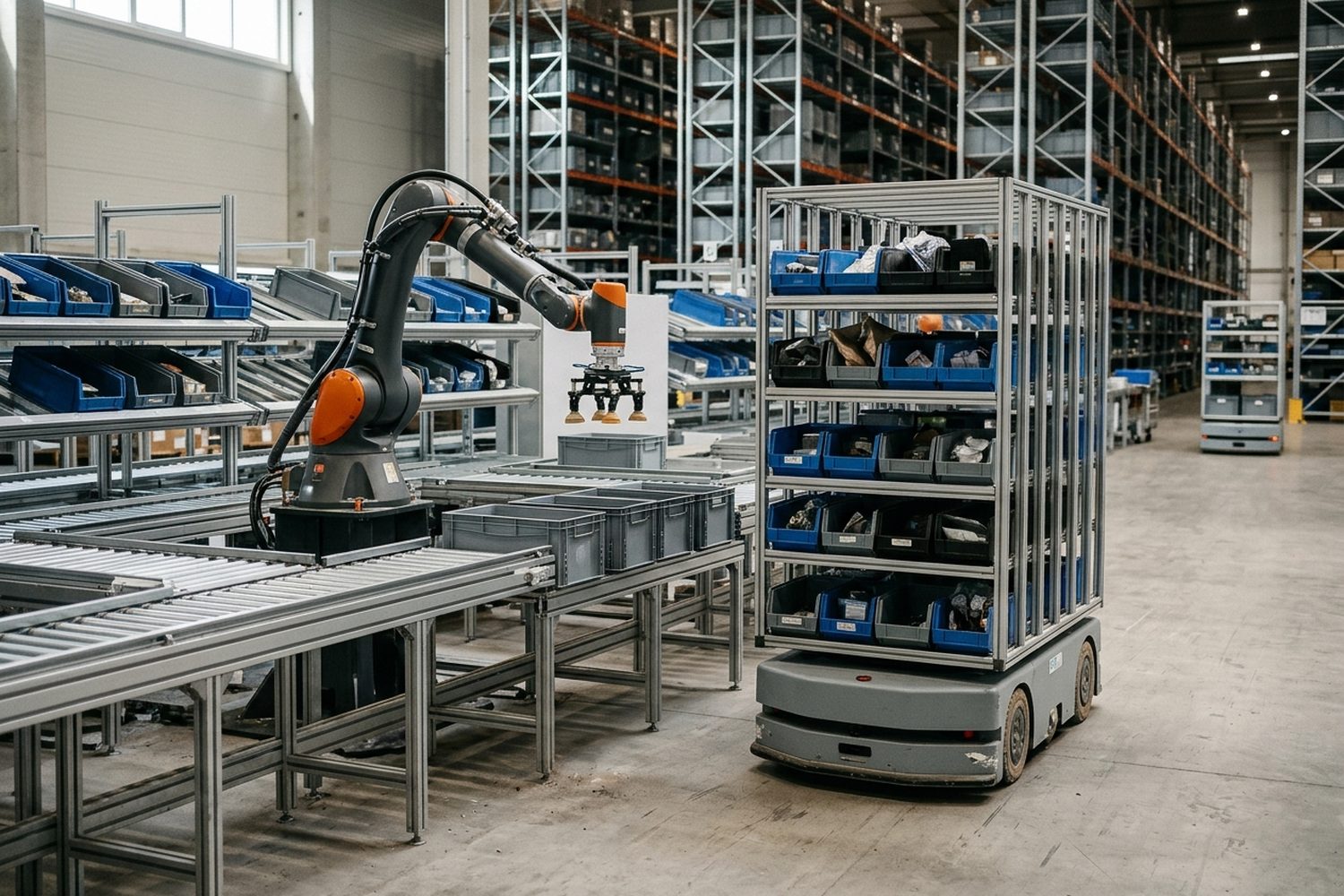
Pick-and-Pack Robots: What They Do Well and What They Drop
A pick and pack robot is really three machines: goods-to-person movers, picking arms and packers. See which numbers hold up and which step has no public data.
-
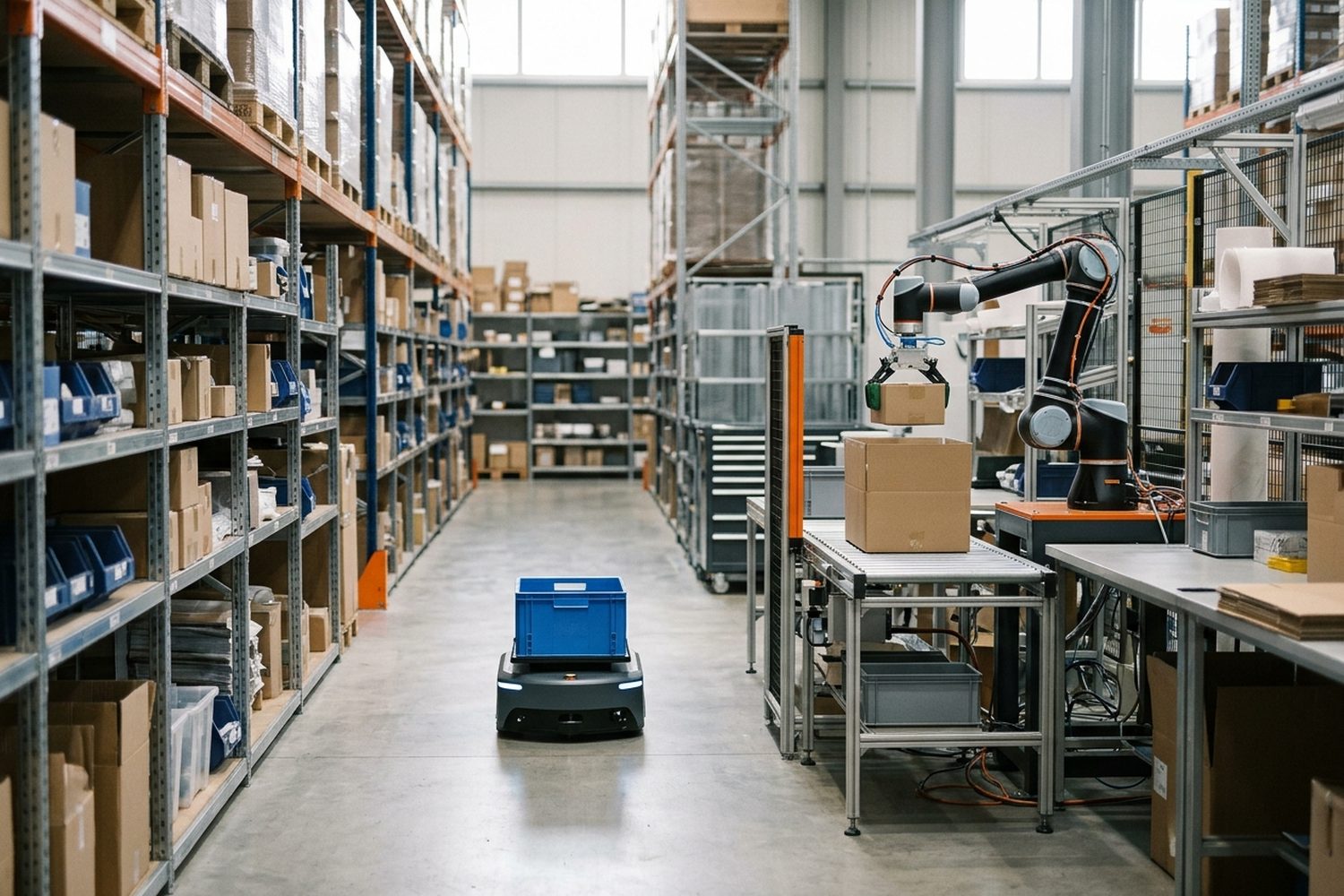
Warehouse Robots: A Field Guide to Every Type
A field guide to warehouse robots, from tape-following AGVs to AMRs, goods-to-person, AS/RS, arms and palletizers, with what each costs and how far adoption has got.
-
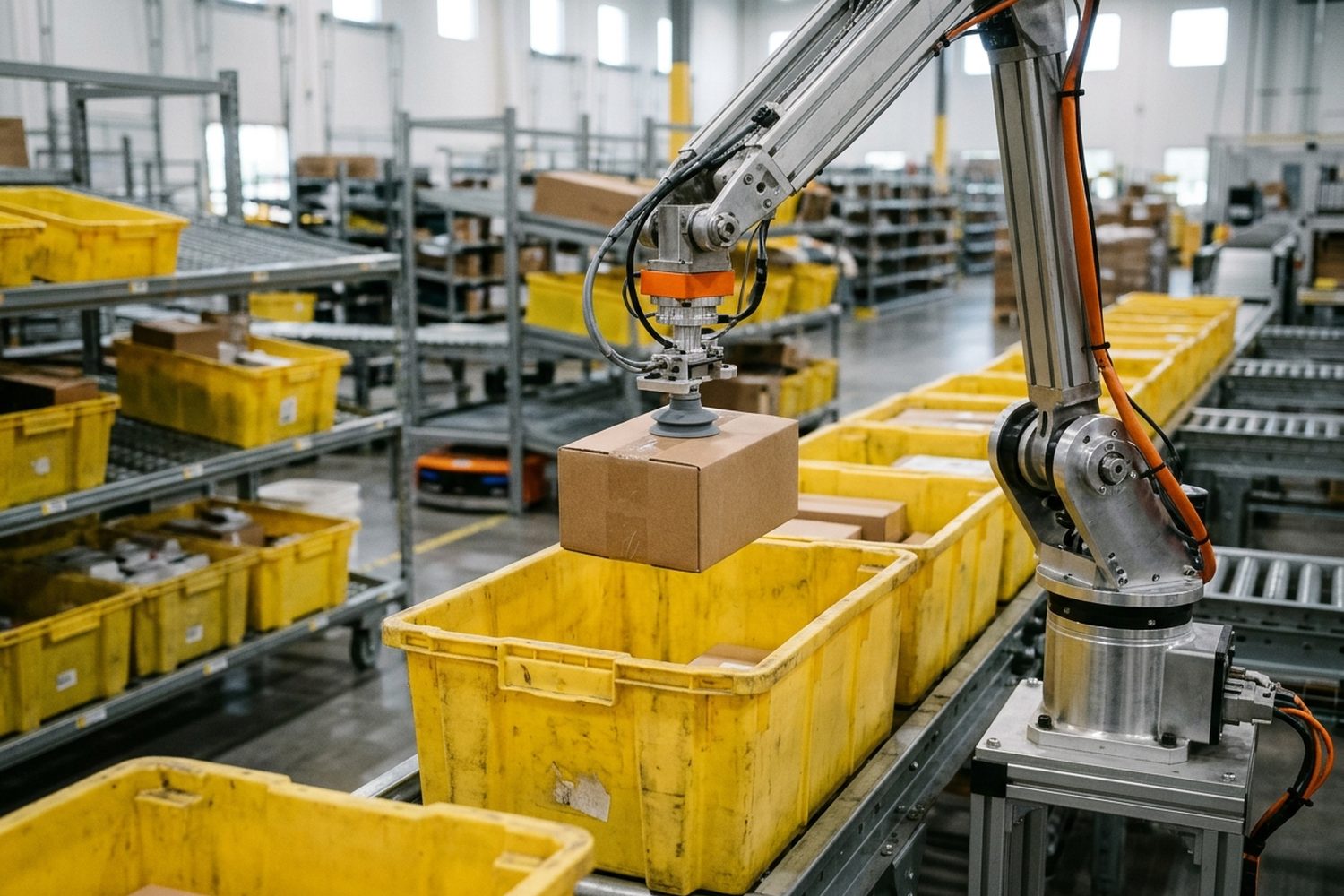
Piece-Picking Robots: The Hardest Job in the Warehouse
How a piece picking robot works: the grippers, tool changing and code checks, who sells them, and why market forecasts are precise while pick speeds go unpublished.


Everything else we have written
- Order Picking Accuracy: Formulas, Thresholds and the Cost of a Mistake
Order picking accuracy explained: why a 98% score is only the floor, how line-level and order-level grades differ, and what each picking error costs.
- What an AMR Costs: Purchase, Lease and the Hidden Line Items
The cost of autonomous mobile robots runs $40,000 to $80,000 for a flat platform, but integration and upkeep make the robot only about half the bill.
- AMR Market Size: Why the Estimates Range From $2.5B to $4.7B
The autonomous mobile robots market was worth $2.5 billion or $4.7 billion in 2025, depending on the report. Here is how the counts, shares and forecasts differ.
- Amazon Warehouse Robots After Kiva: Hercules, Titan, Sparrow, Vulcan
How Amazon warehouse robots work, from Hercules and Titan drive units to Sparrow, Vulcan and DeepFleet, and why a million machines now mostly get in each other's way.
- What Still Limits Warehouse Automation
A look at warehouse automation costs and limits: why picking labor savings run 20% to 50%, how payback stretches with each rung, and where integration bills pile up.
- Truck Unloading Robots: The Mixed-Case Problem
Looking for a pickle robot? Pickle has no published unloading rates, so this compares Mujin's pallet figures, human pick rates and why mixed cases are hard.
- Warehouse Automation Payback: How to Do the Math
Warehouse automation roi explained: typical payback ranges, where savings come from, how utilization and ramp stretch the timeline, and why business cases miss.
- Pick Rates and Error Rates: Robots vs People, Measured
A look at picking productivity as published: human, goods-to-person and robot rates, error figures, and why the vendor and operator numbers measure different things.
- The Order Picker: The Job Robots Are Slowly Learning
What an order picker does all day, how robots change the walking but not the grab, and what pick rates, accuracy and market figures say, plus the injury data nobody publishes.
- Order Picking Methods: Discrete, Batch, Zone and Wave
Order picking explained: how discrete, batch, zone and wave methods divide up the walking that eats most of picking time, and what goods-to-person robots change.
- Right-Sized Boxes: The Quiet Automation That Pays
Packsize explained: how on-demand box making trades air for equipment, why dimensional weight drives the savings, and where public cost numbers run out.
- Packing Robots and Automated Bagging
A packing robot is usually a bagger, box maker or arm cell. Here is what the vendor numbers say, why 75% at the station shrinks to 30% across a whole operation.
- The Robotic Arm in Logistics: Specs That Matter
A robotic arm is judged on payload, reach and cycle time. Here is what a warehouse pick cycle of 3 to 9 seconds shows about where the arm matters.
- Cube Storage and AS/RS: Warehouses Built Like a Rubik's Cube
How an asrs trades aisles for density, why fleet traffic rather than robot speed limits throughput, and what the vendor density claims leave out.
- Kiva to Amazon Robotics: The Acquisition That Changed Warehouses
Amazon robotics kiva systems explained: Kiva became Amazon Robotics after a $775 million 2012 deal, and the fleet now includes Hercules, Sparrow and Vulcan.
- Goods-to-Person: Bring the Shelf to the Picker
How goods to person picking works, why vendor speedup claims run from 2x to 5x or more, and how the unit being counted explains most of the spread.
- AGV vs AMR: Fixed Paths vs Free Roaming
How AGVs differ from AMRs: floor-guided paths versus onboard sensing, what each costs to buy and integrate, and how few warehouses have adopted either.
- Autonomous Mobile Robots in Warehouses
How autonomous mobile robots cut warehouse walking time, what studies and vendors claim about them, and why market size and payback figures vary by source.
- Machine Learning for Grasp Planning: Dex-Net and After
How robotic grasping works in warehouses: learned grasp quality scores, simulation training, tactile sensing, and diffusion models, plus where the methods still fall short.
- Suction vs Finger Grippers: Why Warehouses Mostly Suck
A robot gripper is the end-effector that touches the item. Learn how suction, parallel jaw, hybrid and tool-changing designs split the work of warehouse picking.
- Robotic Picking Research: From the Amazon Picking Challenge Onward
A look at robotic picking research, from the Amazon Picking Challenge to benchmarks and warehouse products, and why grasping is still unsolved a decade on.
| Input | Why it moves the payback |
|---|---|
| Order lines per day | Robots pay back on volume. A quiet building pays for idle machines. |
| Share of items the gripper can handle | Every item a robot refuses goes back to a person. |
| Loaded labour cost per hour | The saving is hours not worked, so the wage sets the size of the prize. |
The full worksheet adds published pick rates and error rates for people and machines, the costs buyers forget, and a worked payback example you can change to fit your building.
The Pick-and-Pack Automation Payback Worksheet
Work out whether picking or packing robots pay back in your building: the inputs that matter, published pick rates and error rates for people and machines, and a worked payback example.